
How to Buy Vintage Jewelry: Hallmarks, Condition and Questions to Ask
26 October 2026
A practical guide to gold marks, settings, measurements and documentation, for anyone choosing a vintage piece to wear or give.
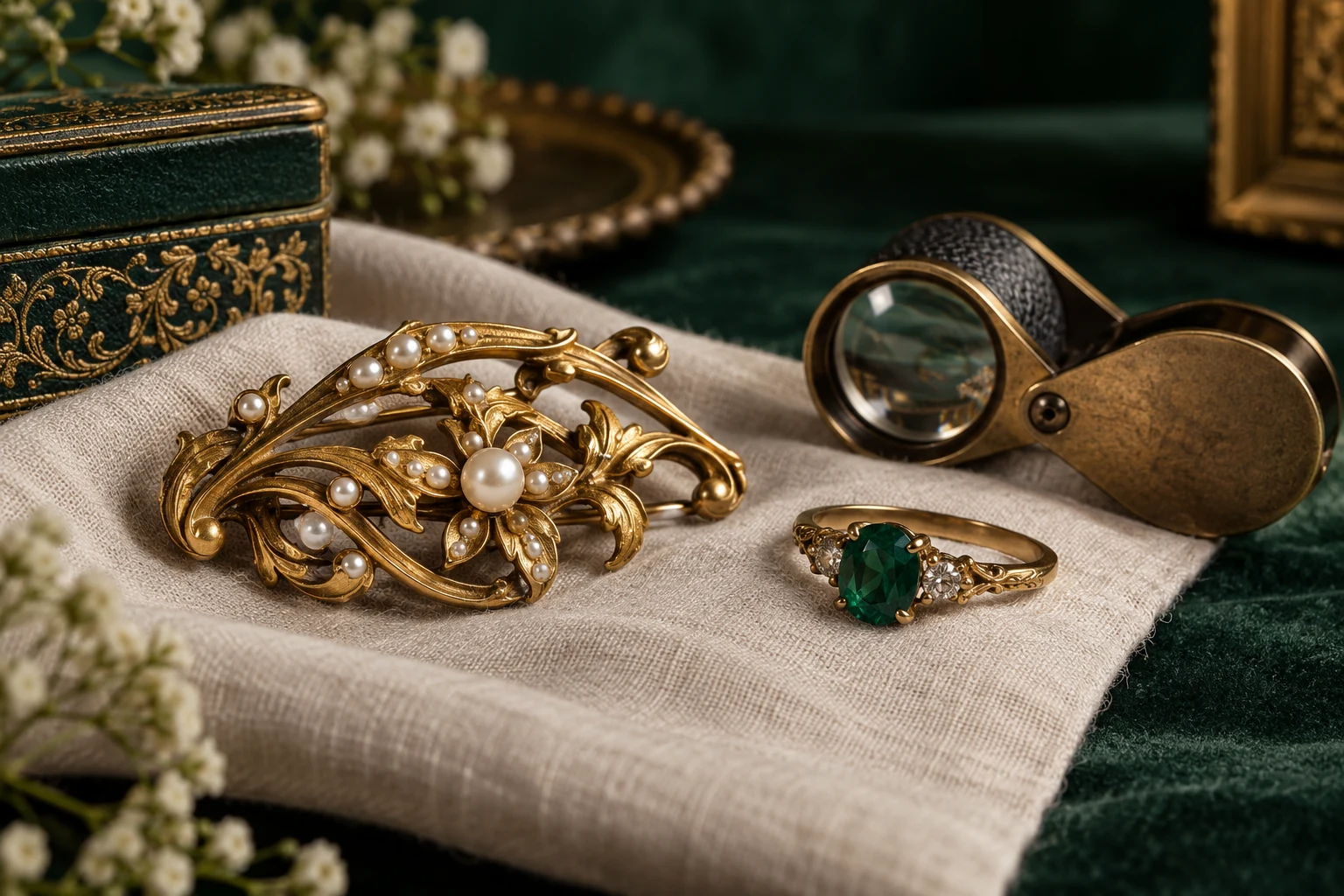
The main image is an AI-generated illustration and does not show a specific item from the inventory.
Before buying vintage jewelry, check the metal and gemstones, the condition of settings and clasps, the measurements and the available documentation. A hallmark or an attractive photograph supplies only part of the information. Your decision should reflect the description, the piece's present condition and how you intend to wear it.
You can begin without being an experienced collector. A ring, brooch or pair of earrings that catches your eye is a useful starting point. Turn that first impression into specific questions before you buy.
Start with the way you want to wear it
Decide whether you are looking for an everyday ring, a brooch for a jacket, earrings for special occasions or a gift. This helps narrow the selection and makes gaps in a description easier to spot.
For a ring, ask about the size and the height of the setting. For earrings, check length, weight and fastening type. With a necklace, the actual length affects where it sits on the body. If measurements use an unfamiliar sizing system, ask which system applies rather than relying on a conversion from a photograph.
Browse Gallery 74's jewelry collection, or begin with the ring selection if that is the type of piece you have in mind.
Vintage, pre-owned and vintage-inspired jewelry
Pre-owned describes previous ownership. Vintage usually describes an object from an earlier period. Vintage-inspired can describe a newly made piece designed with historical influences.
Ask what date or period is attributed to the object and what supports that description. Documented dating and a stylistic assessment are different kinds of information. If the period is central to your purchase, request the attribution in writing.
What do gold marks mean?
A fineness mark describes the proportion of gold in an alloy. Gold may be marked in karats, such as 18K, or in parts per thousand, such as 750. GIA explains these systems in its guide to gold engagement rings.
375
Common karat equivalent: 9K
Gold content indicated: 37.5%
585
Common karat equivalent: 14K
Gold content indicated: 58.5%
750
Common karat equivalent: 18K
Gold content indicated: 75%
These figures describe metal composition. They do not identify a gemstone, date the jewelry or establish who designed it. A visible mark should be considered alongside the object and the information supplied about it.
What else can a hallmark tell you?
A maker's mark and an assay mark serve different purposes. Some hallmarking systems can also provide clues about an assay office or period. Interpretation requires the relevant system and historical context. GIA discusses the different roles of precious-metal marks.
Request a sharp close-up of every mark and a photograph of the complete piece. If a mark is worn or unclear, ask how the metal was assessed and what is documented.
Look beyond the front of the piece
The front photograph draws attention to design. The back, sides and moving parts help explain condition. Ask about:
- Missing stones, chips or settings that need attention.
- The operation of clasps, hinges and chain connections.
- Known resizing, soldering or earlier repairs.
- Wear where the piece touches the body or other objects.
Two rings marked 750 may have very different shank thicknesses, settings and repair histories. Compare those details separately. If a stone may be loose, request a professional assessment before wearing or cleaning the piece. GIA's jewelry care guidance explains why cleaning methods must take gemstones and settings into account.
Ask what the documents actually cover
Request a specification that distinguishes total jewelry weight from gemstone weight, where known. When color, clarity or stone identity is stated, ask whether the information comes from a laboratory report or an assessment of a mounted piece.
If a report is included, establish which stone or stones it concerns. A report about a gemstone does not answer every question about the age or maker of the complete jewel. Keep the description, photographs and relevant correspondence. Read Gallery 74's purchase terms and clarify any work you may want carried out.
Plan care before you buy
Ask how to clean and store the specific piece. Gemstone treatments, metalwork and setting condition can affect the appropriate method. Until you have suitable advice, avoid experimenting with cleaning products, heat or polishing.
Can every vintage ring be resized?
Resizing must be assessed individually. Ask a suitable professional to consider the construction, decoration and setting, and explain the work and its likely effect on the piece.
Is vintage jewelry a suitable gift?
Check the practical details as carefully as the design. If you do not know the recipient's ring size, consider a type of jewelry that does not depend on finger size. Confirm measurements, fastening and the applicable exchange terms.
Take a closer look at a specific piece
Explore the jewelry catalog, choose a piece and note the questions its description leaves open. Contact Gallery 74 with the item link to request clarification before purchasing.